General information, not safety or legal advice. Safe Work Australia writes the model laws but does not enforce them; your state or territory’s work health and safety regulator does, and Victoria has its own laws.
Note 1 · Definitions
What counts as demolition work
The model code defines demolition work as demolishing or dismantling a structure, or part of one, where it is load-bearing or is otherwise related to the structure’s physical integrity. It leaves out taking down formwork, falsework and scaffolding, and removing power, light or telecommunication poles. A structure is anything constructed, fixed or moveable, temporary or permanent, from buildings and sheds to towers, chimney stacks, silos and storage tanks.
Demolition is a kind of construction work, so the construction rules apply to it too. The model laws have been implemented in every jurisdiction except Victoria, some with variations, and a model code has legal effect only where a jurisdiction approves it. In Victoria, EPA Victoria points builders to WorkSafe Victoria for health and safety guidance.
Note 2 · Before work starts
The paperwork that comes before the machines
The model code sets out who carries which duty. A PCBU, a person conducting a business or undertaking, is the code’s term for whoever runs the work; it sometimes calls the one controlling the demolition the demolition contractor.
| Duty | When it applies | What the code says |
|---|---|---|
| Safe work method statement | Before any high risk construction work, including demolition of a load-bearing element. | It must identify the work, its hazards and risks, how they will be controlled and how the controls will be checked, and be developed in consultation with the workers doing it. If the work strays from it, it must stop and resume only in line with the statement. |
| Notice to the regulator | Demolition of a structure, or a load-bearing part, at least 6 metres high; demolition using load shifting machinery on a suspended floor; demolition with explosives. | Written notice at least five days before the work starts. Height is measured from the lowest ground level next to the base of the structure to its highest point. |
| Principal contractor | A construction project, meaning construction work costing $250,000 or more. | One principal contractor, with duties that include a WHS management plan, signage, site security, and taking all reasonable steps to get a copy of each safe work method statement before high risk work starts. |
| Emergency plan | Every workplace. | Written procedures for responding, evacuating, calling emergency services and getting medical help, with testing and training. |
| Licences | Some demolition work, and work such as asbestos removal or using explosives. | Ask the local work health and safety regulator or building regulator whether the work needs a licence. |
Where demolition involves more than one business, such as subcontractors, the code says a demolition plan should be prepared. If as-built drawings are missing, or the structure may have been weakened by fire or decay, or plant will work on suspended floors, it says a competent person such as a qualified structural engineer should carry out an engineering investigation first.
Note 3 · Licences
Licences differ by state: two examples
New South Wales
SafeWork NSW has two demolition licences, restricted and unrestricted, needed to demolish or partly demolish most buildings and structures. For load-bearing demolition, SafeWork NSW lists two triggers for a restricted licence: a structure between 6 and 15 metres high, and the use of load-shifting machinery on a suspended floor, with the example of an excavator on a suspended floor of a home.
A licence lasts 5 years, holders appear on a public register, and a SafeWork-approved named supervisor must be on site supervising whenever licensed demolition work is carried out.
Western Australia
WA has two classes of demolition licence, Class 1 and Class 2, each valid for three years. WA’s licensing page says demolishing a fence or wall 1.8 metres or higher needs a licence, as does demolishing a structure 2 metres or higher. Its scope-of-work page words the licence’s scope as a structure 2 metres or higher that is not a single storey dwelling, so for a single storey house, check with the Department of Local Government, Industry Regulation and Safety, which runs WA’s demolition licensing.
Class 1 covers structures 10 metres or more high, and also demolition that uses load-shifting equipment on a suspended floor, works on pre-tensioned or post-tensioned structural components or on precast concrete elements erected by the tilt-up method, removes key structural members so a structure collapses, uses explosives, uses a tower crane or any crane with a safe working load over 100 tonnes, or removes more than 200 square metres of brittle or fragile roofing where any part is 10 metres or more above the ground. Class 2 covers structures under 10 metres, other than single storey dwellings and the Class 1 kinds of work in that list.
Both states let you check a licence: SafeWork NSW adds licence holders to a public register, and WA’s demolition licensing page has an online search to check whether a licence number is still valid.
Note 4 · Method
Top down, in reverse order
The code says the order of demolition can be critical for the safety of workers and the public. Buildings should generally be demolished in reverse order to their construction, which it calls sequential demolition:
- From the roof downIn reasonably even stages, starting from the roof or top of the structure.
- Storey by storeyA multistorey building is taken down one storey at a time, and masonry and brickwork in reasonably even courses.
- Stable at every stageWhatever the method, the structure and its parts should be kept stable so nothing collapses unexpectedly, with temporary bracing, propping or shoring where needed.
- Machines before handsManual demolition with jack hammers, sledgehammers and picks should only be considered where mechanical demolition is not reasonably practicable.
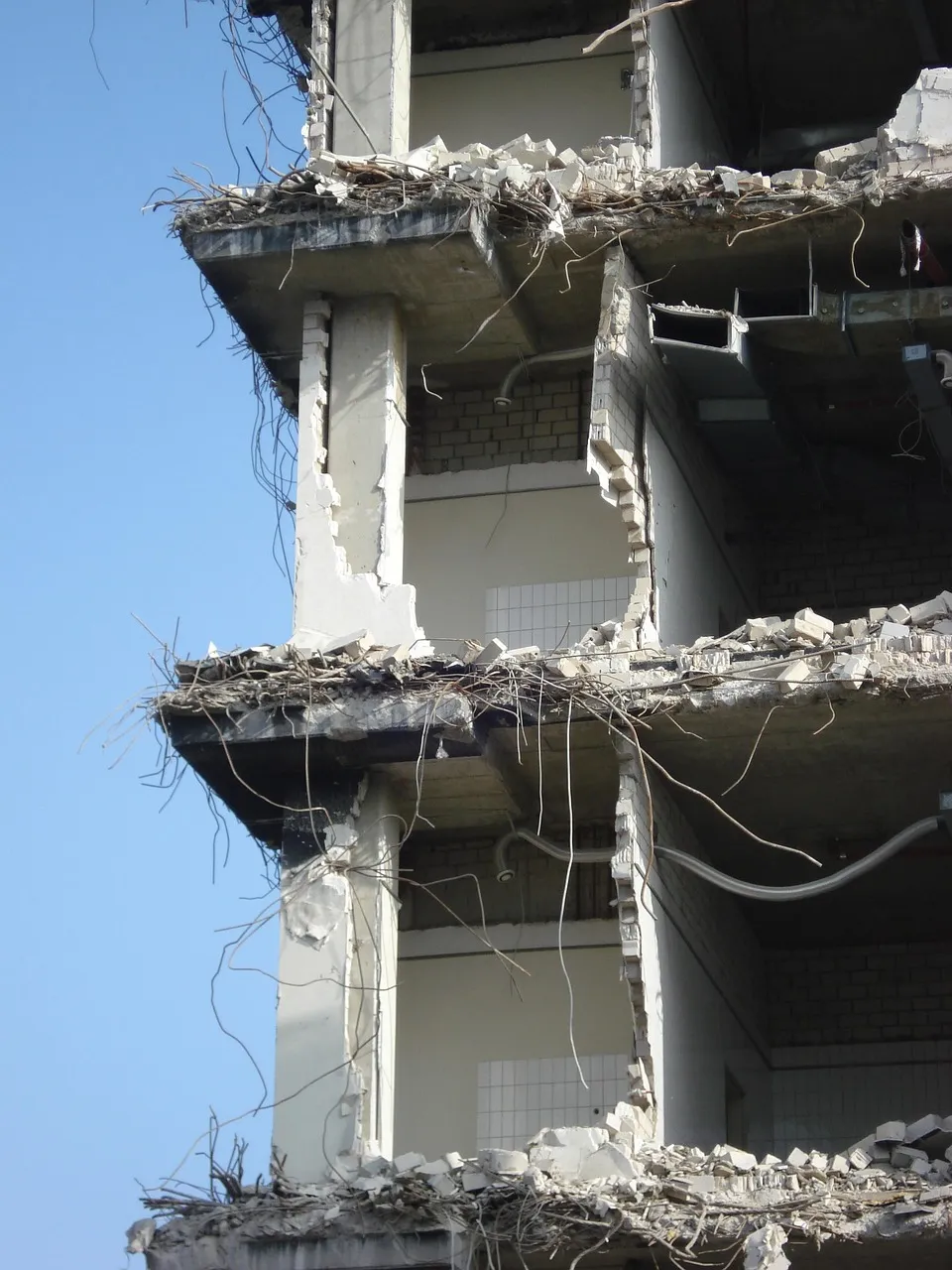
The code asks for exclusion zones where falling objects might land, the workplace secured against unauthorised entry, and, beside a public place with a risk of falling debris or hazardous noise, protection such as hoarding, overhead structures over walkways or road closures, put up before demolition starts. Demolished material should not fall freely unless it is confined in a chute, shaft or exclusion zone.
Neighbours are part of the plan. The code says no part of the demolition should weaken another building, that lateral support for an adjoining structure should be at least what the demolished building gave it, and that the work should not cause flooding or water to enter a neighbouring building. SafeWork NSW sums up why: demolition can lead to structural collapse, exposes workers to dust, silica and asbestos, and risks hitting electrical lines.
Asbestos is the part of that list to hand over entirely. The Asbestos and Silica Safety and Eradication Agency says it is “not recommended that you handle or remove asbestos yourself”, and New South Wales and Western Australia set limits in law: in New South Wales a home owner may legally take out non-friable material covering less than 10 square metres themselves, but must take the same strict safety precautions as professional removalists, and any friable material, or more than 10 square metres, needs a licensed removalist; in Western Australia a home owner may remove non-friable material covering less than 10 square metres themselves but must follow strict safety precautions and wear personal protective equipment, and any friable material, or non-friable material over 10 square metres, must be removed by a licensed removalist. The national agency adds that asbestos waste can only go to a landfill licensed to accept it. Sheet 03 covers finding and removing it.